I arrived in the night and awoke to...the Alps! I arrived in
Bozen (after some train mix up) at 1:30 AM and walked 1 minute down the street to a beautiful youth hostel with a bathroom in each room! It was very nice to stay there and a nice change from traveling. When I woke I only had a 40 minute train ride to
Merano where
Nik picked me up and drove me to the Agriculture Museum.


So, let me
introduce you to
Brunnenburg Castle, Agricultural Museum. Here is a way for people to see what agriculture is like in the Alps. They have historical equipment and heritage breed animals. Because of the slope, special tools may be used in unique ways to grow food and support livestock in these beautiful
mountains. Here is a view from where the animals live of the castle that I live next to (there are several at
Brunnenburg). In this castle there are apartments for Nona (grandmother),
Nik (my "boss"), and other family members.

Here is where I live. Go up the stairs and into the little door. I will move up to the main castle next week after some other guests leave. Its a wonderful place to live. There will be no other students here while I am here so I have the place all to myself!

This is the courtyard that goes up to my room.

This is the view a few steps out my front door - you guessed it! Another castle.
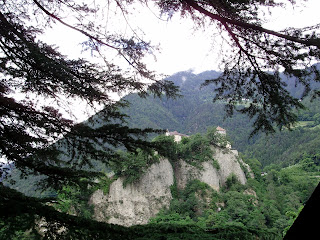
Here is to the left, showing how productive the little village of
Sudtirol is! They are some of the biggest producers of apples and grapes in Italy! What a wonderful way to live!

While exploring I found this beautiful part of the castle! Notice anything magnificent about this place? There is a tree growing IN the castle! How fantastic!

Here is one of the many "secret staircases" in the castle. Its so much fun when you find one! Everything is on the edge, so views are spectacular.

This is the view from that lovely cedar tree growing in the castle balcony.

Heritage Breeds on the farm:
This is Mira and Bella, the two Mangalitsa Swein. They are woolly pigs! They are wonderful girls, the love scratches, peanuts, and to go for walks! (They have a boyfriend too, but he's staying in the hut in the picture).
This breed was originally bred in Hungary and are endangered. Austria currently has a breeding program where Brigitte and Sizzo got Mira and Bella from. Both are going to farrow (have piglets) later this summer. They should have 4 - 6 piglets each.  There are also two Blaue Tiroler Ziege (Blue Tirolean Goats) on the farm:
There are also heritage breeds of Poultry at the agriculture museum. Below is a pair of ducks.
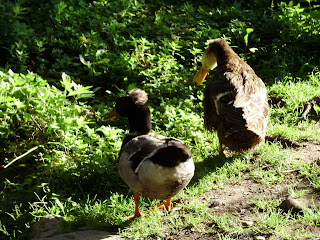
The term "heritage breed" refers livestock old breeds of livestock that are usually in danger of becoming extinct. Before simple and fast transportation, many regions could have more than 20 breeds of one kind of livestock (be it goat or pig) that was acclimated to the certain area. They would be resistant to local parasites, do well on little or poor, local forage, and be manageable on a small farm. They did not have a lot of offspring and were not high producers like today's breeds in modern agriculture. It simply was not needed on a small homestead. Mira, Bella, and Gulliver (the pigs) originated in Hungary and are being bred mainly in Austria now, they are a fairly local breed, here in Dorf Tirol. The goats are originally from the Tirol region, and the poultry here are all alpine breeds as well
Breeding heritage varieties of livestock is improving the genetic diversity of that breed. Having a diversity of breeds promotes biodiversity, which is important for many reasons. Biodiversity is a major concern in the environmental movement with conservation projects as well. There are also other heritage breeds on this farm, so stay tuned for more pictures.
Viticulture, Lesson 1: planting new vines
Grape growing starts with a new vineyard. Over the winter Nik, his family and friends, built stone walls to reinforce a new vineyard. Below is the finished product (before vines). Nik showed a friend (Miche) and I how to finish straightening the posts before he put the wire in.
These particular grapes came by mail in this box, and were stored in a moist, cool environment until we could take them out for planting. This is a new variety that Nik is going to work with this year that is fungi-resistant. He will be able to see what kind of wine it makes after harvest in about three years. My first assignment was to cut the ends of the roots so they could assimilate water more easily and stimulate growth. We then put them in crates of water and brought them down to the vineyard for planting. Nik put the holes in while Miche and I planted.
The tops of these grapes are green, they were sealed with wax when they were sent to keep them sterile and keeps them from being damaged. There are buds poking through on many of these vines - they are ready to be out in the sun! Here is the first stage: fill the hole halfway with dirt. We then go back and fill each hole with water. We keep planting while the water is absorbed into the soil, then go back and fill in the holes.
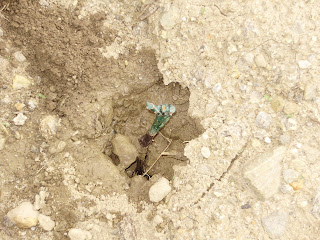 Here is a hole filled in with a little "mote" around it to keep water from the irrigation system from running off.
 Here are the loving hands making the moat.
 Here is the owner of the hands!
 There are amazing places to be seen from anywhere on the mountain. I can't wait to go further up for hiking and exploring. The only way to truly enjoy this is to actually experience it. The pictures just don't do it justice.
Thank you for reading about my trip to Italy. I will post again before I leave and I hope you email me with any questions while I am here. As you can see - I'm having a blast!
email: whitemountainllamas@hotmail.com

 While cutting back the brush I chased out a scorpion! They're pretty cool. They are small and black and apparently only sting like bees.
 Brunnenburg is seemingly in the middle of nowhere, but what's nice is that as you climb out of paradise you end up in a little village called Dorf Tirol. Here are the outskirts of it on the hill. Its an cool view from the castle :)
 Here are a few pictures of the trail that leads down to the new vineyard, weberacker. The climate is just a little bit warmer so that there are more plants. Vines cover trees and there is green everywhere! What a beautiful place to work :)


 Here is the bean patch that I weeded and mulched.

 Here is a picture of the sweet corn and squash that I planted below the garden. This will also be the winter pig area. After the corn is harvested, the pigs will have fun pulling down the stalks and eating it! I will also seed some other plants around the corn to help with runoff and for roughage in the fall/winter.
 Viticulture
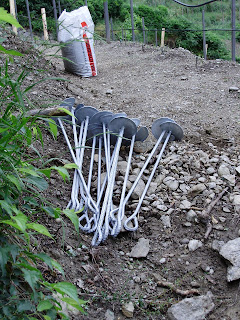 Here are a few that are almost finished.
 Here are


 This is the youngest unicorn. She is very shy, and has one crooked horn.
 Here is the


